Research one grounded idea
Start with one reader problem, the audience’s actual questions, and source notes you can check. Separate facts from assumptions.
Deliverable: 5 verified points and 2 useful sources.
Turn a single, verified idea into useful, channel-ready content without copying the same message everywhere. This six-step checklist prioritizes accuracy, fit and reliable links.
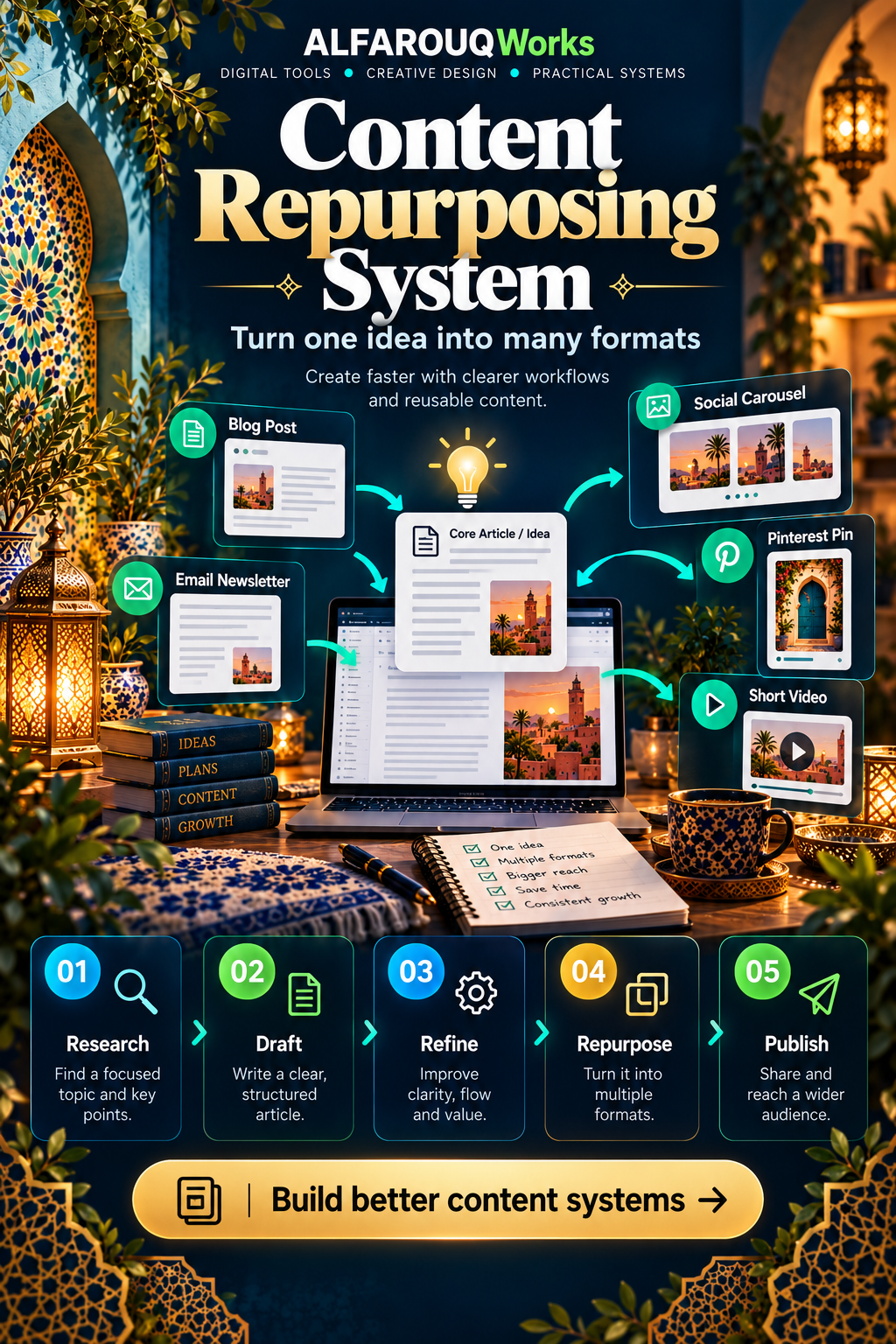
Finish each stage before you begin the next. AI can speed up drafts; it cannot replace source checks, audience judgment or publication QA.
Start with one reader problem, the audience’s actual questions, and source notes you can check. Separate facts from assumptions.
Choose one takeaway, a clear promise, an ordered structure, and a next action. The structure must work without AI.
Ask AI to turn your approved notes into a first draft. Do not let it invent statistics, quotes, customer outcomes or product features.
Check facts against sources. Remove repetition, fix awkward language, confirm original examples, and review accessibility and brand voice.
Adapt the master to each channel. A Pinterest Pin needs a clear image and destination; a newsletter needs context; a short video needs a script.
Test links, disclose affiliate relationships, mark AI-generated visual assets where required, and measure meaningful clicks over vanity metrics.
Adapt the format and user intent, not just the word count. All outputs should point to the same truthful underlying resource.
Problem → steps → examples → next action.
Readable image + accurate title + directly relevant link.
One hook, 4–6 useful panels, one honest CTA.
Short context, one valuable example, one link.
45–60-second script with a useful takeaway.
Copy this structure into your editor, then replace the brackets with actual source information.
Use the free 10-point landing-page self-audit to confirm that the destination behind your content has a clear promise, a working action, and appropriate trust information.
Open the free landing-page audit →